
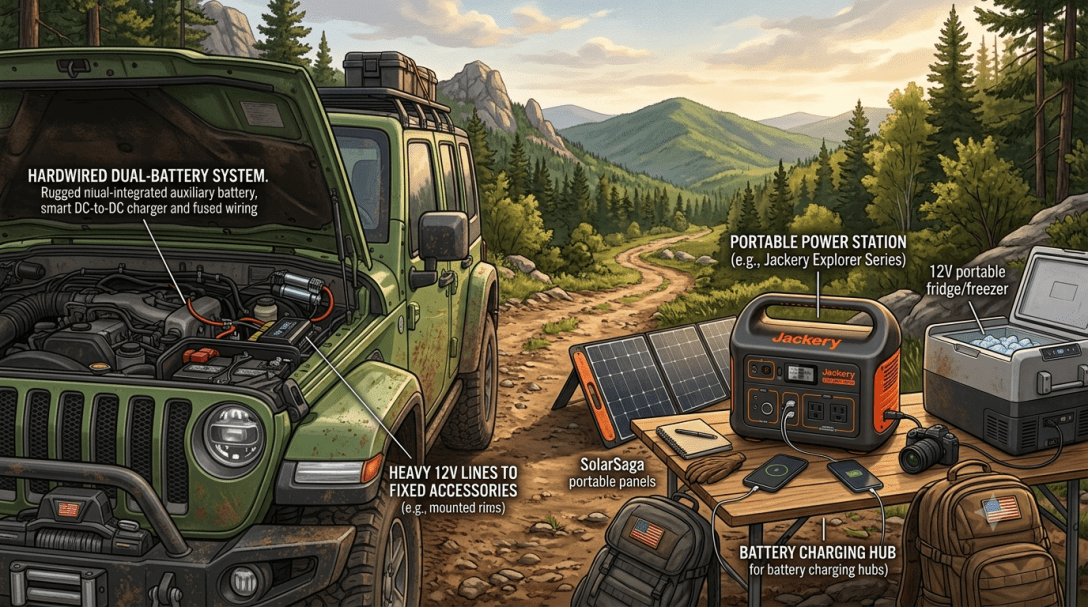
Setting up power for an off-road rig usually comes down to a fundamental choice: do you tear into your Jeep’s factory wiring to install a hardwired second battery, or do you throw a portable lithium power station in the back and call it a day?
Both approaches work, but they solve different problems depending on how you build your rig and how you camp.
The Case for Hardwired Dual-Batteries
A traditional dual-battery system places an auxiliary battery directly in your engine bay or integrated into a cargo area drawer build. Connected through an isolator or a DC-to-DC charger, it recharges automatically whenever the engine is running.
If you run high-draw, fixed equipment—like onboard air, hardwired trail/chase lights, or an integrated 12V fridge mounted on a slide—a permanent dual-battery system makes a lot of sense.
Where it shines:
- Charge speed while driving: A proper DC-to-DC charger pulls heavy amperage straight from your alternator, topping off your battery fast during short dirt connector trails.
- Out of sight: It doesn’t take up cabin or cargo floor space.
- Set-and-forget: You turn the key, the system charges, and you never have to plug anything in.
Where it stumbles:
- Installation overhead: It takes actual wrenching, wiring, fusing, and routing thick copper lines through firewalls.
- Zero portability: The power stays with the Jeep. You can’t carry it to a picnic table, take it inside a ground tent, or haul it into the house when the power goes out at home.
The Case for Portable Power Stations
I use a Jackery setup (specifically running Explorer units) because my rig setup needs to be flexible. Portable power stations combine a battery, inverter, solar controller, and outlets into one self-contained unit.
Instead of plumbing 12V lines through your Jeep, you strap the unit into the cargo area, plug your fridge or gear straight into it, and hit the trail.
Where it shines:
- Zero installation: No cutting wires, no messing with the vehicle’s electrical system, and no voiding warranties on newer models with complex smart alternators.
- Camp flexibility: You can pull the unit out of the rig and set it up anywhere—down by the water, inside a tent, or at a ground camp.
- Solar convenience: If you camp in the shade, you can park under the trees, throw a portable solar panel out in the sun on an extension lead, and keep your power topped off all day.
Where it stumbles:
- 12V charging speeds: Charging a large portable power station from a standard 12V auxiliary plug while driving is relatively slow compared to a high-amp alternator line.
- Cargo footprint: It sits inside your cabin or cargo space, so you have to budget floor real estate for it, which is always at a premium in a Wrangler.
How to Decide
If you have a dedicated trail rig with custom cargo drawer systems, heavy 12V wiring, and you spend days driving long distances back-to-back, a hardwired dual-battery system is worth the installation effort.
If your rig is also your daily driver, or if you want a system that can charge drone batteries, run camp lights, power a fridge, and then get carried inside to run essential electronics during a storm at home, a portable power station is usually the smarter route.
Plenty of setups end up using a mix of both over time, but starting with a portable unit gives you immediate off-grid power without touching a single wire on your Jeep.


